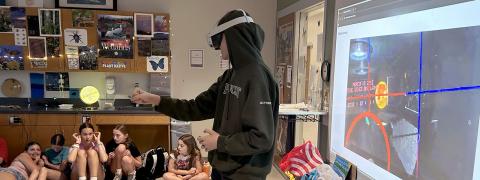
Take a virtual field trip to outer space with our NASA-sponsored VR Classroom for Space Physics. Great for education and public outreach at schools, workshops, events, and more!
Space, like Earth, has weather. And just like hurricanes, tornadoes, and other storms can cause lots of damage, geomagnetic storms in space can also cause damage – damage to astronauts, satellites, and the society we have built on the ground. The University of New Hampshire is building satellites to better study and predict space weather. We have taken Space Weather events, as well as the satellites, instruments, and data we use to study it, and put them into a Space Station in Virtual Reality for all to enjoy.
The Space Station has a media room for learning about space weather and satellite missions, games and instruments for interactive exploration, and a data viewing platform to visualize and explore space weather events. We are able to bring outer space closer to home so kids and adults alike can play with learn about space weather in a way we learn best – by exploring!
About Us
VR Laboratories for STEM Classrooms


Data Visualization
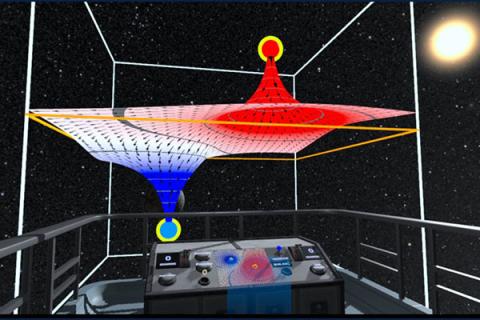
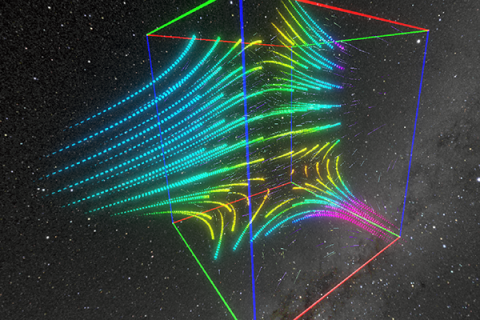
Turn 3D datasets into explorable, interactive visualizations. Below are examples (left to right): 3D flow fields and slices, particle tracing in electromagnetic fields, and cutting planes with Hairy slices in 3D vector fields.



You can now download the free Space Physics Laboratory app on the Meta Quest app store.
Step into orbit with NASA MMS, a hands-on VR experience that blends immersive simulation with real science. Designed in collaboration with NASA’s Magnetospheric Multiscale Mission, this interactive journey puts you inside a stylized space station environment filled with holograms, games, and physics.


Contact & Info
 Saturday, Sept. 19 | 10:30 am - 4:00 pmMcAuliffe-Shepherd Discovery Center
- Saturday, Oct. 17 | 10:30 am - 4:00 pmUNH Observatory
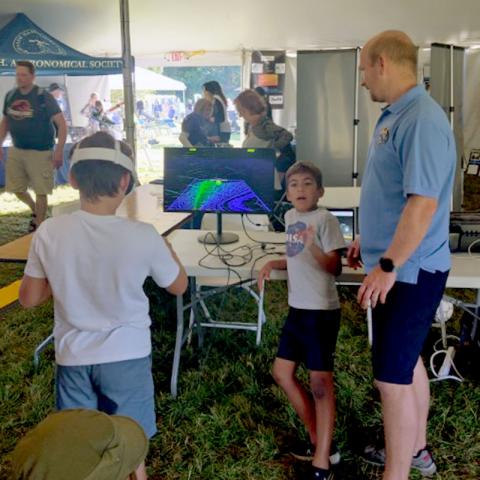

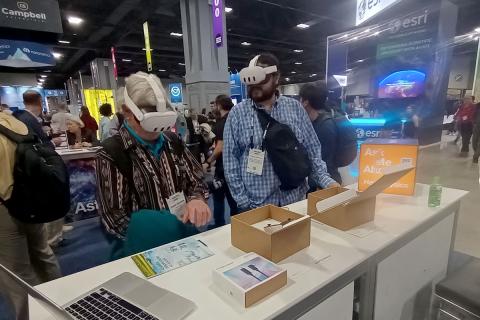
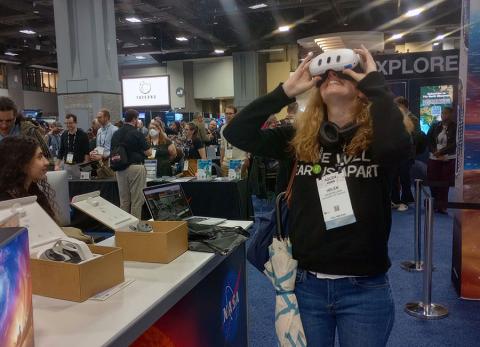
Our Mobile VR Lab has five Meta Quest 3 Headsets available for classroom or event demonstrations.
Book Your VR Visit!
If you have questions or would like the Space Physics Mobile VR Lab to visit your classroom or event, please email Mobile.VRLab@unh.edu
Scope
This is the privacy policy for the Space Physics Laboratory virtual reality application developed for the Unity app store by the University of New Hampshire, Southern New Hampshire University, and Mean Free Path Laboratories, LLC. It conforms to the privacy policy requirements of the Meta Quest app store.
Data Collected
Two classes of data are collected within the app: answers to academic questions for evaluation, and interaction statistics.
- Laboratory Questions
Laboratory activities within the Space Physics Laboratory capture user input in the form of speech-to-text, interactive answer selections, and typed or written answers. These answers to laboratory questions can be saved to the headset and later distributed further by the user. They are not collected by the app developers. - Interaction Statistics
Some objects in the Space Physics Laboratory capture anonymous interaction statistics, including the number of times the object is touched, held, or viewed, and the amount of time the object was touched, held, or viewed. These statistics are uploaded to a central data server. This data is tagged with a unique identifier(the device MAC Address) and general location details.
Data Usage
Answers to laboratory questions are meant to be evaluated for educational purposes. Users can record their answers and present them to the lab instructor for evaluation. Object interaction statistics are used to determine which elements of the app are most interesting to the users and to generate ad revenue from sponsors.
Right to Delete Personal Information
Users may request that their personal information be deleted by emailing Mobile.VRLab@unh.edu
